
I recently put this article together for someone wanting to reduce noice in a recently-installed AFM. However, it also applies to an AFM where somethign has changed, or where new experiments (i.e. measurements of small features) demands a lower noise level than has been previosuly available.
A lot od this article is based on having an AFM in an antivibration isolation cabinet, whthin wihch the system floats on aa platform based on rubber bungee cords. This is one of the most common setups, especially if the noise isolation is self-built. SOm eof the other considerations are appropriate for any setup, however.
Introduction
Acoustic or vibration based noise can enter the system from a wide variety of sources. The procedure to reduce noise is firstly to establish a standardised method to measure noise. This is often discussed in your instrument manual. There are also procedures described in Appendix B of my book. Once this is done, a baseline measurement is made. If the result is unsatisfactory, adjustments are made followed by further measurements, until the required level is achieved. It is worth noting the value supplied by the AFM manufacturer upon delivery of your system. This can be considered and ideal or target value. It is unlikely that the user will achieve a result superior to (i.e. lower than) this value.
Things to check
1. Probe and sample. If in any doubt, use a new probe, and ensure the probe holder is clean before mounting it. The sample could be the calibration sample supplied with the instrument. It does not need to be performed on the active area with the square patterns, any clean part of the silicon is fine. It can be worth performing a test image scan to be sure the probe and sample are good before measuring noise, if in any doubt. Any dirty probe or sample may introduce noise. If either the probe or sample are not rigidly mounted, noise will be introduced.
2. Transient versus constant noise. Transient noise such as people opening and closing doors, talking, moving furniture, etc, should be eliminated before starting, as much as possible. TEhre could also be transient noise outside the lab where the AFM is installed (for example, vehicles moving nearby, machinery in an adjacent room). The rest of the guide assumes that the source of noise is constant.
3. Badly setup antivibration chamber. With any antivibration solution, the system needs to be setup properly to function properly. Here are some things to check:
a. Floating platform much not be touching walls or base of box. Check this carefully, as sometimes the elastic bungees can stretch a little over time, and it possible that the base of the box may touch a part of the AFM support platform, negating isolation.
b. Poorly elastic bungees. The bungee cords need to support the platform such that it can move up and down slowly (<2Hz) upon experiencing a force. If the cords are stretched over many years, they will lose their elasticity.
c. Unfixed cable/s entering the box. Where the cables enter the rear of the box, they are a source of noise ingress. Check they are properly clamped in place and not free to move at the rear.
d. Cable/s stretched too tight. On the other hand, when the system is floating, the part of the cables within the box need to have some play, so they don’t couple the platform rigidly to the box.
e. Loose screws. Not very common, but its always worth checking were are not loose screws, or a loose cover on the AFM itself.
4. Noise on the AFM box support table. If the antivibration box is mounted on a table there should be no other sources of noise on that table, such as loose equipment, computer fans, etc. ideally the antivibration box sits on it’s own, sturdy mount, that is not used for anything else, such as in the case of the “Q-box” and Q-base” see below.
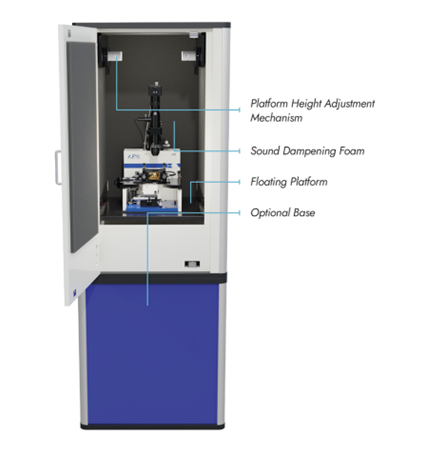
|
Figure 1. The AFMWorkshop “QBox” (white part) and “QBase” (blue part). The QBase is a rigid support for the QBox. Because they have the same cross section, there is no extra space on the QBox for people to mount equipment or leave loose items! |
5. External vibrations in the room, or adjacent to the room. An air conditioning or other ventilation outlet pointed at the antivibration box will introduce noise. Pumps or other equipment operating nearby can introduce noise. Antivibration boxes can reduce this noise, but may not eliminate it.
6. Incorrectly chosen scaning settings. The method for measuring the noise level in your system should ideally include specification of the scanning parameters used, but it's always worth checking the scning parameters are correct. As an example if feedback aprameters (PID settings) are too high, they may introduce noise into the system.Very low or very high set points can also affect this.
7. Digital Aliasing. This is the effect of trying to measure a very smal noise level, and not having enough digital resolution in the A to D converter to measure the actual noise level. It will also affect measurent of really small features in the same way. Often this can be overcome in software.